When discussions turn to the environmental toll of the automotive sector, tailpipe emissions dominate the conversation. Smog hanging over urban freeways, carbon dioxide emissions from gasoline combustion, and the race toward zero tailpipe standards receive the vast majority of public attention. Yet, a vehicle begins leaving an ecological mark long before its tires touch a showroom floor or its engine turns over for the first time.
Modern automotive manufacturing is one of the most resource-intensive industrial endeavors on Earth. Building a single passenger car requires extracting thousands of pounds of raw minerals, consuming immense amounts of electricity and fossil energy, expending thousands of gallons of water, and processing complex synthetic chemicals. As the industry transitions rapidly from internal combustion engines to electrified platforms, the environmental footprint is shifting upstream from the highway to the factory floor. Understanding the full environmental equation requires looking closely at how automobiles are conceived, assembled, and distributed around the globe.
Raw Material Extraction and Refining Demands
Every vehicle rolling off an assembly line represents a mosaic of refined elements pulled directly from the crust of the earth. The production cycle begins in open-pit mines, quarries, and brine pools scattered across continents, each accompanied by substantial ecological disruption.
-
Steel and Iron Production: Traditional passenger cars remain roughly fifty to sixty percent steel and iron by weight. Producing virgin steel relies heavily on blast furnaces fueled by metallurgical coal, releasing massive plumes of carbon dioxide and particulate matter into the atmosphere. The smelting process also creates slag waste and heavy metal runoff that threatens local watersheds if containment basins fail.
-
Aluminum Smelting: Automakers have turned to lightweight aluminum alloys to trim vehicle mass and meet fuel economy standards. However, turning raw bauxite ore into automotive-grade sheet aluminum requires Hall-Heroult electrolytic smelting, a process that consumes staggering amounts of electrical power and generates potent greenhouse gases, including perfluorocarbons.
-
Petrochemicals and Plastics: The modern automobile interior, along with exterior bumpers, lighting housings, and wiring insulation, depends heavily on virgin polymers derived from crude oil and natural gas cracking. The refinement of petroleum resins releases hazardous air pollutants, including benzene, toluene, and volatile organic compounds.
-
Glass and Rubber Sourcing: Melting silica sand to create shatterproof windshields demands sustained high-temperature furnaces running continuously on natural gas. Concurrently, synthetic rubber production draws on petrochemical inputs, while natural rubber cultivation drives deforestation and habitat fragmentation in vulnerable tropical ecosystems.
The Manufacturing Process Inside Assembly Plants
Once raw materials are transformed into rolls of sheet metal, plastic pellets, and glass panes, they travel to primary stamping, welding, and assembly facilities. Within these multi-million-square-foot complexes, several production phases generate acute local and global environmental strain.
Stamping and Robotic Welding
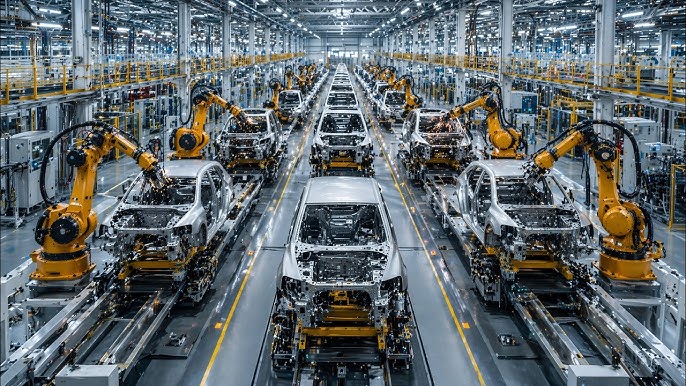
Large mechanical presses stamp flat metal coils into hoods, doors, floor pans, and structural pillars. While metal stampings generate clean scrap that factories routinely collect and remelt, the secondary remelting loop still requires supplemental energy. Following stamping, automated robotic arms join structural pieces using resistance spot welding, laser joining, and industrial adhesives. The thermal energy required to operate thousands of automated welding heads across continuous eight-hour shifts draws immense loads from local electrical grids, much of which is still generated by fossil fuel combustion.
The Chemical Burden of the Paint Shop
Environmental health specialists consider the paint shop to be the most chemically hazardous sector of an automotive assembly plant. Preparing a bare steel or aluminum frame to resist decades of corrosion involves multiple harsh chemical baths:
-
Pretreatment and Electrodeposition: Vehicle bodies pass through zinc phosphate baths and alkaline cleaners to strip oils before entering electrocoat dip tanks, which utilize electrical charges to adhere protective primers to the bare metal. This stage generates industrial wastewater laden with phosphate salts, heavy metals, and toxic sludge that requires rigorous on-site treatment facilities.
-
Topcoat and Clearcoat Application: High-volume automated spray booths apply base colors followed by high-gloss protective clear coats. Despite the widespread adoption of waterborne paint formulations, automotive painting still vents volatile organic compounds into the atmosphere, contributing to ground-level ozone formation. Thermal oxidizers burn off many of these vapors, but operating those oxidizers consumes vast quantities of natural gas.
Electric Vehicle Batteries and the Upstream Burden
The global automotive transition toward battery electric vehicles fundamentally changes the timeline of environmental harm. While an electric car produces zero operational emissions, its manufacturing phase carries an environmental burden roughly forty to seventy percent higher than that of an equivalent gasoline-powered sedan.
This imbalance stems almost entirely from the high-voltage lithium-ion traction battery pack. Mining and processing battery-grade raw materials introduces specialized environmental challenges:
-
Lithium Extraction: Lithium extracted from continental brine deposits across South America requires evaporating millions of gallons of underground water in hyper-arid regions, stressing indigenous agricultural communities and disrupting local aquifers. Alternatively, hard-rock spodumene lithium mining relies on heavy open-pit excavation and acid-leaching circuits that produce substantial mine tailings.
-
Cobalt and Nickel Refining: Refining battery-grade nickel and cobalt generates sulfur dioxide emissions and acidic tailings. High-pressure acid leach plants processing nickel laterite ores generate massive quantities of toxic waste that require deep-sea tailings placement or precarious inland tailing dams.
-
Battery Cell Fabrication: Synthesizing nickel-manganese-cobalt cathodes and purifying graphite anodes demands superheated industrial kilns that run for days at temperatures exceeding two thousand degrees Fahrenheit. Furthermore, cleanroom dry rooms, where battery cells are assembled and vacuum-sealed to prevent moisture contamination, run powerful industrial dehumidifiers twenty-four hours a day, driving up the plant electrical footprint.
Industrial Water Consumption and Waste Streams
Automotive plants require millions of gallons of fresh water daily to function. Cooling massive metal stamping dies, mixing chemical solutions in paint shops, cooling robotic resistance welders, and conducting final high-pressure cabin leak tests all deplete local municipal water supplies.
In water-stressed regions, this industrial draw can depress local groundwater tables and compete with municipal drinking water needs. While modern closed-loop recycling systems capture and filter water for reuse within the plant, significant fractions evaporate as waste steam or become contaminated sludge requiring off-site hazardous waste disposal in specialized industrial landfills.
Global Logistics and the Fragmented Supply Chain
A completed vehicle contains approximately thirty thousand individual components, ranging from microprocessor chips and steering racks to carpet fibers and seat belt tensioners. Automotive manufacturing operates on a highly decentralized, just-in-time delivery model.
Sub-assemblies frequently cross international borders multiple times before reaching the final assembly line. Raw bauxite mined in Australia may travel to Iceland for smelting, ship to Germany to be stamped into an engine block, cross to Mexico for integration into a powertrain, and finally arrive in the United States for final vehicle assembly. The heavy maritime freighters, long-haul diesel freight trucks, and cargo aircraft orchestrating this global dance burn vast volumes of bunker fuel and diesel, generating an enormous logistics footprint that rarely appears on a consumer efficiency window sticker.
Frequently Asked Questions
How long must an electric car be driven to offset the emissions created during its manufacture?
The operational break-even point for an electric vehicle typically ranges between fifteen thousand and sixty thousand miles of driving, depending directly on the electricity sources powering the local utility grid. When charged on grids powered heavily by renewable energy like wind or solar, the manufacturing debt is erased in less than two years of normal commuting. If charged exclusively on coal-dominant grids, offsetting the initial battery manufacturing footprint takes considerably longer.
Can modern automotive factories operate entirely on renewable energy?
Several automotive assembly plants have achieved net-zero operational status on paper by investing in on-site solar arrays, capturing landfill methane for heat, and purchasing renewable energy credits. However, completely severing an automotive plant from fossil fuels remains difficult due to the continuous high-heat requirements of thermal oxidizers, curing ovens, and backup power generators.
What percentage of a modern automobile is made from recycled materials?
In current vehicle production, recycled content accounts for roughly twenty to twenty-five percent of total vehicle weight, primarily concentrated in recycled steel frames, aluminum engine components, and post-consumer plastics used in trunk liners and underbody acoustic shielding. Automakers are actively working to scale closed-loop recycling for interior textiles and high-purity aluminum alloys.
How does vehicle lightweighting impact overall environmental sustainability?
Switching from heavy steel to lightweight materials like carbon fiber composites, magnesium, and aluminum lowers vehicle curb weight, directly reducing the fuel or battery power needed to propel the car down the road. However, these lightweight materials require significantly more energy and hazardous chemicals to synthesize and refine, meaning the upfront manufacturing footprint rises even as operational consumption drops.
What happens to the hazardous sludge generated by automotive paint shops?
The sludge filtered from paint shop water curtains contains heavy metals, uncured chemical resins, and petroleum solvents. Because it cannot be handled by municipal treatment plants, it is chemically dewatered, treated with drying agents, and either incinerated in high-temperature hazardous waste kilns or sequestered in lined industrial landfills designed to prevent groundwater leaching.
How does the microchip shortage or electronics boom affect automotive emissions?
The modern car is essentially a mobile supercomputer containing dozens of electronic control units and thousands of microchips. Semiconductor fabrication requires massive volumes of ultrapure water, cleanroom energy conditioning, and specialized fluorinated greenhouse gases that have thousands of times the global warming potential of carbon dioxide, substantially expanding the non-mechanical footprint of the vehicle.
Are automakers able to recycle manufacturing scrap within their own factories?
Yes, high-efficiency plants run closed-loop recycling programs for clean sheet metals. Large mechanical offal chutes sit beneath stamping presses to catch leftover aluminum and steel trim cutouts, immediately compressing them into dense cubes that travel back to primary smelters for immediate reprocessing into new automotive sheet metal coils.